L'elmetto del Major Anthony Charles Bovill Malcolm-Sim The helmet of Major Anthony Charles Bovill Malcolm-Sim
Questo elmetto MKII è collegato al Major Anthony Charles Bovill Malcolm-Sim, ufficiale dei Royal Engineers e ingegnere minerario di lunga esperienza. Durante la Seconda guerra mondiale Malcolm-Sim rientrò in servizio e comandò la 171st Tunnelling Company, Royal Engineers, una specialità tecnica nella quale convergevano competenze militari, minerarie e ingegneristiche. This MKII helmet is connected with Major Anthony Charles Bovill Malcolm-Sim, an officer of the Royal Engineers and an experienced mining engineer. During the Second World War Malcolm-Sim returned to military service and commanded the 171st Tunnelling Company, Royal Engineers, a specialist branch in which military, mining and engineering skills came together.
Il pezzo è particolarmente affascinante perché non racconta soltanto la storia di un reparto, ma anche quella di un uomo che attraversò due guerre mondiali: prima come ufficiale delle compagnie di tunnelling nella Grande Guerra, poi come comandante di una unità specializzata dei Royal Engineers nella guerra del 1939-1945. The piece is particularly fascinating because it does not only tell the story of a unit, but also that of a man who lived through two world wars: first as an officer in tunnelling companies during the Great War, and later as the commander of a specialist Royal Engineers unit during the 1939-1945 war.
.jpg)
.jpg)
Elmetto MKII attribuito al Major Anthony Charles Bovill Malcolm-Sim / MKII helmet attributed to Major Anthony Charles Bovill Malcolm-Sim
Il proprietario: Anthony Charles Bovill Malcolm-Sim The owner: Anthony Charles Bovill Malcolm-Sim
Anthony Charles Bovill Malcolm-Sim nacque nel 1884 e morì in ospedale il 30 ottobre 1946, all'età di 62 anni. La sua biografia è quella di un tecnico minerario internazionale: iniziò la carriera nel 1903 con la Rand Mines Ltd. nel Transvaal, in Sudafrica, lavorando dapprima nei vari reparti della miniera Jumpers Deep Ltd.. Anthony Charles Bovill Malcolm-Sim was born in 1884 and died in hospital on 30 October 1946, at the age of 62. His biography is that of an international mining specialist: he began his career in 1903 with Rand Mines Ltd. in the Transvaal, South Africa, first working through the various departments of the Jumpers Deep Ltd. mine.
Dopo tre anni passò per un periodo al dipartimento geologico in Madagascar e fu agente della società nei campi diamantiferi alluvionali del distretto di Bloemhof. Dal giugno 1909 al gennaio 1913 lavorò come assistente saggiatore e chimico presso la City and Suburban Gold Mining and Estate Co. Ltd.; successivamente ricoprì incarichi di metallurgista consulente, saggiatore e chimico per diverse miniere, tra cui la Pilgrims Creek Gold Mining Co. Ltd. e la Southern Van Ryn Reef Gold Mining Co. Ltd.. After three years he worked for a time in the geological department in Madagascar and acted as the company's agent on the alluvial diamond fields of the Bloemhof district. From June 1909 to January 1913 he was employed as assistant assayer and chemist with the City and Suburban Gold Mining and Estate Co. Ltd.; he later held posts as consulting metallurgist, assayer and chemist for several mines, including Pilgrims Creek Gold Mining Co. Ltd. and Southern Van Ryn Reef Gold Mining Co. Ltd..
Dalla miniera alla guerra sotterranea From mining to underground warfare
Nel settembre 1915 Malcolm-Sim si arruolò per il servizio di guerra. La sua competenza tecnica lo portò naturalmente nelle unità di tunnelling dei Royal Engineers, dove servì nella 184th e nella 176th Tunnelling Company. Nel 1918 fu trasferito al quartier generale della First Army e divenne Assistant Controller of Mines, First Army. In September 1915 Malcolm-Sim joined up for war service. His technical expertise naturally brought him into the Royal Engineers tunnelling units, where he served with the 184th and 176th Tunnelling Companies. In 1918 he was transferred to First Army Headquarters and became Assistant Controller of Mines, First Army.
Le compagnie di tunnelling dei Royal Engineers erano reparti altamente specializzati. Nella Prima guerra mondiale si occuparono di guerra di mina, scavo di gallerie sotto le linee nemiche, realizzazione di rifugi sotterranei, postazioni protette, cunicoli di collegamento, trincee per cavi, camere sotterranee per trasmissioni e servizi sanitari. Era una guerra tecnica e durissima, combattuta sotto terra da uomini provenienti spesso dal mondo delle miniere. The Royal Engineers tunnelling companies were highly specialised units. During the First World War they were employed in mine warfare, digging galleries beneath enemy lines, constructing underground shelters, protected positions, communication subways, cable trenches and underground chambers for signals and medical services. It was a hard technical war, fought underground by men who often came from the mining world.
La Seconda guerra mondiale e la 171st Tunnelling Company The Second World War and the 171st Tunnelling Company
Durante la guerra del 1939-1945 Malcolm-Sim rientrò nell'Esercito e comandò la 171st Tunnelling Company, Royal Engineers. Il dato è particolarmente significativo perché collega la sua esperienza mineraria civile, il servizio nella Grande Guerra e l'impiego specialistico dei Royal Engineers nella Seconda guerra mondiale. During the 1939-1945 war Malcolm-Sim rejoined the Army and commanded the 171st Tunnelling Company, Royal Engineers. This is especially significant because it connects his civilian mining experience, his Great War service and the specialist employment of the Royal Engineers during the Second World War.
La 171st Tunnelling Company era già un reparto noto per la propria storia nella Prima guerra mondiale, in particolare per l'attività nel saliente di Ypres, nelle operazioni di mining a Messines e per la costruzione di opere sotterranee come il Vampire dugout. Nella Seconda guerra mondiale il riutilizzo di competenze simili rispondeva a esigenze diverse, ma sempre legate a scavi, protezione, infrastrutture sotterranee e lavori tecnici in condizioni operative. The 171st Tunnelling Company was already known for its First World War history, especially for its work in the Ypres Salient, its mining operations at Messines and the construction of underground works such as the Vampire dugout. In the Second World War similar skills were again required, though for different needs: excavation, protection, underground infrastructure and technical works in operational conditions.
Nel 1943 Malcolm-Sim lasciò il servizio militare per limite d'età e passò alla Directorate of Opencast Coal Production, dove lavorò per circa due anni nella prospezione del carbone in Gran Bretagna. Anche questa ultima fase conferma la continuità della sua figura: un uomo legato alla miniera, alla geologia applicata e all'ingegneria del sottosuolo per tutta la vita. In 1943 Malcolm-Sim retired from military service under the age limit and joined the Directorate of Opencast Coal Production, where he worked for about two years on coal prospecting in Great Britain. This final phase again confirms the continuity of his life: a man connected with mining, applied geology and underground engineering throughout his career.
L'elmetto The helmet
L'elmetto si presenta con una verniciatura esterna chiara, sabbia/khaki, molto vissuta, sulla quale sono applicati due fregi. Da un lato è visibile una grande T rossa entro un motivo circolare scuro; dall'altro compare un rettangolo rosso con bande scure verticali. Il collegamento con Malcolm-Sim e con la 171st Tunnelling Company rende questi segni particolarmente interessanti e meritevoli di ulteriore confronto documentario. The helmet shows a worn light sand/khaki outer finish with two painted markings. On one side there is a large red T inside a dark circular device; on the other side there is a red rectangle with dark vertical bars. The connection with Malcolm-Sim and with the 171st Tunnelling Company makes these markings especially interesting and worthy of further documentary comparison.
.jpg)
.jpg)
Dettagli dei fregi dipinti / Details of the painted markings
All'interno si conserva una scritta con le iniziali del proprietario, leggibile come A.C.B.M-S, compatibile con Anthony Charles Bovill Malcolm-Sim. Questa marcatura interna è il punto più importante del pezzo: permette di passare da un elmetto tecnicamente interessante a un oggetto personale collegato a una biografia precisa. Inside the helmet there is an owner's marking, readable as A.C.B.M-S, consistent with Anthony Charles Bovill Malcolm-Sim. This internal marking is the most important feature of the piece: it turns a technically interesting helmet into a personal object connected with a precise biography.
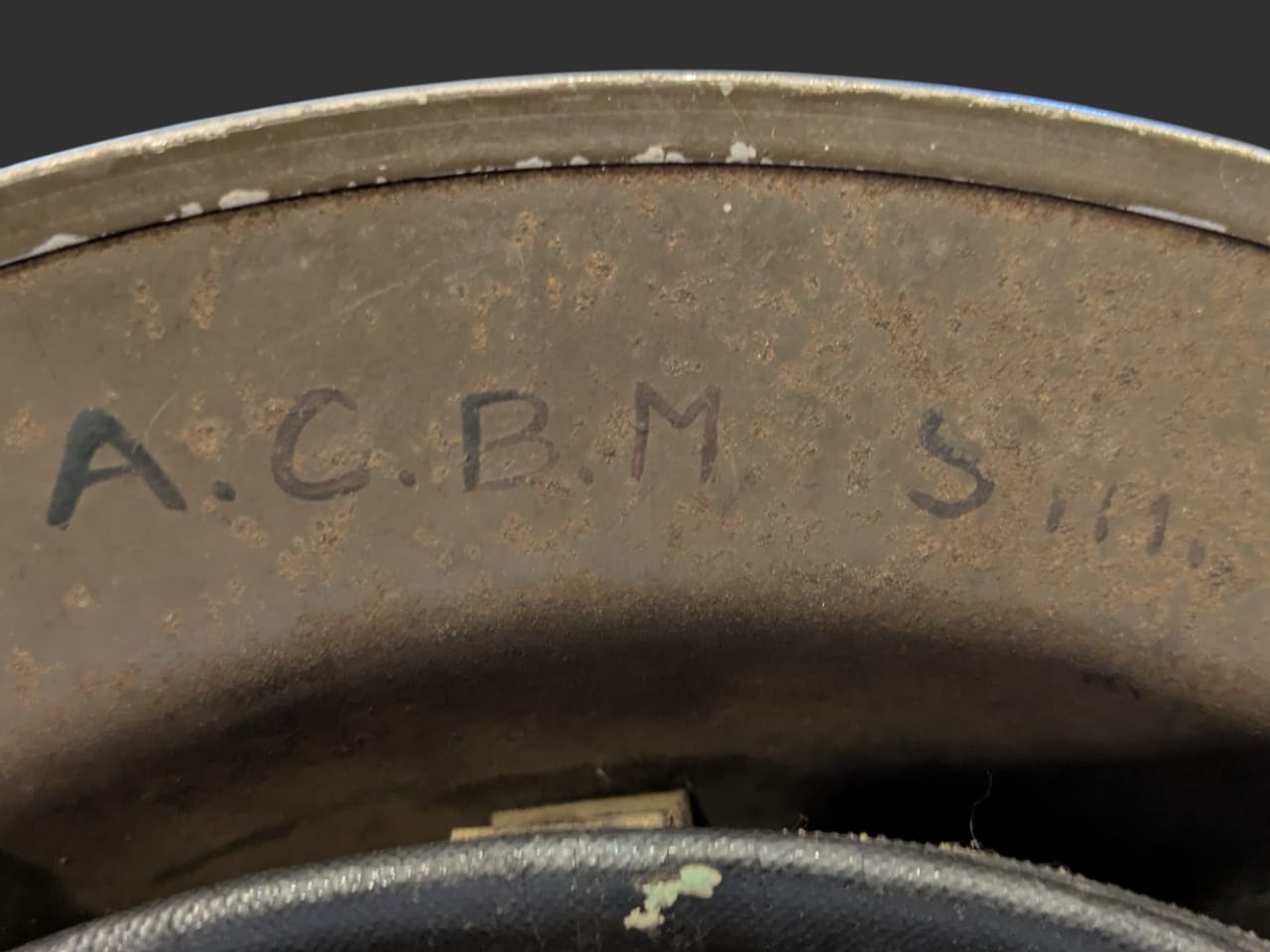
Marcatura interna con le iniziali A.C.B.M-S / Internal marking with the initials A.C.B.M-S
L'insieme dell'elmetto, della vernice, dei fregi e della marcatura interna lo rende un reperto di grande livello: non solo un MKII legato ai Royal Engineers, ma un oggetto che permette di raccontare la continuità fra esperienza mineraria civile, guerra sotterranea della Prima guerra mondiale e specializzazione tecnica nella Seconda. The combination of the helmet, its finish, painted markings and internal name makes it a high-level piece: not only an MKII connected with the Royal Engineers, but an object that tells the continuity between civilian mining experience, underground warfare in the First World War and technical specialisation in the Second.
La memoria Memory
Anthony Charles Bovill Malcolm-Sim morì il 30 ottobre 1946. La fotografia della lapide riporta il nome Anthony Charles Bovill Malcolm-Sim, il grado di Major, il corpo dei Royal Engineers e l'età di 62 anni. Dopo una vita trascorsa tra miniere, guerra tecnica, servizio militare e lavori di prospezione, il suo nome resta legato a una forma di guerra meno visibile ma essenziale: quella degli ingegneri, dei minatori e degli specialisti del sottosuolo. Anthony Charles Bovill Malcolm-Sim died on 30 October 1946. The photograph of his grave marker records the name Anthony Charles Bovill Malcolm-Sim, the rank of Major, the Royal Engineers and the age of 62. After a life spent between mines, technical warfare, military service and prospecting work, his name remains connected with a less visible but essential form of war: that of engineers, miners and underground specialists.
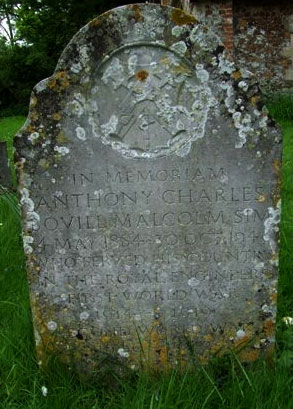
Lapide del Major Anthony Charles Bovill Malcolm-Sim / Grave marker of Major Anthony Charles Bovill Malcolm-Sim
Conclusione Conclusion
Questo elmetto è quindi molto più di un semplice oggetto militare. È il punto d'incontro fra una marcatura personale, un reparto specialistico dei Royal Engineers e la biografia di un uomo che portò la propria esperienza mineraria dentro due conflitti mondiali. Un pezzo che unisce tecnica, storia militare e vicenda individuale. This helmet is therefore much more than a simple military object. It is the meeting point between a personal marking, a specialist Royal Engineers unit and the biography of a man who brought his mining experience into two world wars. A piece that combines technical detail, military history and an individual life story.
Collezione privata Daniele Piselli
Private collection Daniele Piselli
Riferimenti / References:
- Northern Mine Research Society, Anthony Charles Bovill Malcolm-Sim: https://nmrs.org.uk/resources/obituaries-of-members/obituaries-of-members-names-beginning-with-m/anthony-charles-bovill-malcolm-sim/
- The Auxiliaries, A.C.B. Malcolm-Sim: https://www.theauxiliaries.com/men-alphabetical/men-s/sim-acbm/acb-malcolm-sim.html
- 171st Tunnelling Company, Royal Engineers: materiale storico e bibliografico consultato online.
- Osservazione diretta dell'elmetto e delle marcature presenti sul pezzo.

