Alexander James McLean - Un elmetto canadese MKII con una storia precisa Alexander James McLean - A Canadian MKII helmet with a documented story
Recentemente ho acquisito questo elmetto canadese MKII, prodotto dalla G.S.W. nel 1940, inizialmente per un dettaglio tecnico non comune: i supporti del liner risultano montati al contrario. Osservandolo meglio, però, il pezzo si è rivelato molto più interessante del previsto. All'interno del guscio sono infatti presenti alcune marcature manoscritte che permettono di collegarlo a un soldato canadese ben documentato: Private Alexander James McLean. I recently acquired this Canadian MKII helmet, manufactured by G.S.W. in 1940, initially because of an unusual technical detail: the liner lugs are mounted in reverse. On closer inspection, however, the helmet proved to be much more interesting than expected. Inside the shell there are handwritten markings that make it possible to link it to a well-documented Canadian soldier: Private Alexander James McLean.
.jpg)
.jpg)
Elmetto canadese MKII GSW 1940 / Canadian MKII helmet, GSW 1940
Le marcature interne Internal markings
Le iscrizioni visibili all'interno dell'elmetto riportano i dati essenziali del proprietario e del suo primo reparto:
B20035 A.M. - C.F.C. - 11 COY
Il numero B20035, le iniziali A.M. e l'acronimo C.F.C. hanno permesso di ricondurre il pezzo ad Alexander James McLean, arruolato nel Canadian Forestry Corps. La sigla C.F.C. è particolarmente importante: non rimanda a un reparto di fanteria, ma a un corpo di supporto specializzato nella produzione e nella fornitura di legname, risorsa essenziale per lo sforzo bellico.
The markings visible inside the helmet record the owner's essential details and his first unit:
B20035 A.M. - C.F.C. - 11 COY
The number B20035, the initials A.M. and the acronym C.F.C. made it possible to identify the helmet as belonging to Alexander James McLean, who enlisted in the Canadian Forestry Corps. The C.F.C. marking is especially important: it does not indicate an infantry unit, but a support corps specialized in producing and supplying timber, an essential resource for the war effort.
.jpg)
.jpg)
Marcature interne e dettagli del liner / Internal markings and liner details
.jpg)
.jpg)
Dettagli interni dell'elmetto / Internal helmet details
Dal Canadian Forestry Corps alla fanteria From the Canadian Forestry Corps to the infantry
Alexander James McLean nacque il 29 aprile 1909 a Kenmore, Ontario, nei pressi di Ottawa. Proveniva da una famiglia rurale e numerosa, abituata al lavoro della terra e del bosco. Prima della guerra visse per anni nella fattoria di famiglia, contribuendo alla costruzione della casa e della stalla, al pagamento delle tasse e al sostegno dei genitori. Alexander James McLean was born on 29 April 1909 in Kenmore, Ontario, near Ottawa. He came from a large rural family accustomed to farm and forestry work. Before the war he lived for years on the family farm, helping to build the house and stable, pay taxes and support his parents.
Si arruolò nel Canadian Forestry Corps il 13 agosto 1940. Dopo l'addestramento avanzato oltremare nell'aprile 1941, fu impiegato come Edgerman e Log Canter, mansioni legate alla lavorazione del legname. Questo servizio, meno appariscente rispetto a quello dei reparti combattenti, fu comunque fondamentale: il legname serviva per costruzioni, infrastrutture, imballaggi, opere campali e per molte necessità logistiche dell'esercito. He enlisted in the Canadian Forestry Corps on 13 August 1940. After advanced overseas training in April 1941, he was employed as an Edgerman and Log Canter, jobs connected with timber processing. Although less visible than service in combat units, this work was essential: timber was needed for construction, infrastructure, packing, field works and many logistical requirements of the army.
Il 12 ottobre 1943 rientrò in Canada e gli fu concesso un periodo di congedo forestale di sei mesi. Rimase però lontano dal servizio solo una settimana. Un documento di selezione del personale del 18 aprile 1944 mostra la sua disponibilità a rientrare in servizio attivo. Avrebbe voluto essere assegnato ai Royal Canadian Engineers, anche per servire accanto al fratello minore Norman, già oltremare con la 14th Field Company, R.C.E., ma non poté essere inserito in quel reparto per mancanza dei requisiti specifici richiesti. On 12 October 1943 he returned to Canada and was granted a six-month forestry leave. However, he stayed away from service for only one week. A Personnel Selection Record dated 18 April 1944 shows his willingness to return to active duty. He wished to join the Royal Canadian Engineers, partly in order to serve with his younger brother Norman, who was already overseas with the 14th Field Company, R.C.E., but he could not be accepted into that unit because of the specific qualifications required.
Nonostante questo, McLean rimase disponibile e collaborativo, dichiarandosi pronto a servire anche nella fanteria se necessario. Nel 1944 la situazione dei reparti canadesi in Italia rese questa disponibilità decisiva: le perdite subite nelle unità combattenti e la scarsità di rincalzi portarono al trasferimento di molti uomini provenienti dai servizi di supporto verso reparti di prima linea. Il 16 settembre 1944 Alexander James McLean fu quindi assegnato ai Cape Breton Highlanders, R.C.I.C., per essere impiegato come fante. Despite this, McLean remained willing and cooperative, stating that he was ready to serve in the infantry if necessary. In 1944 the situation of Canadian units in Italy made this willingness decisive: losses in combat units and the shortage of replacements led many men from support trades to be transferred to front-line formations. On 16 September 1944 Alexander James McLean was therefore posted to the Cape Breton Highlanders, R.C.I.C., to be employed as an infantryman.
La Campagna d'Italia e il fiume Lamone The Italian Campaign and the Lamone River
La nuova assegnazione portò McLean in uno dei momenti più duri della Campagna d'Italia. Dopo l'avanzata lungo la penisola, i reparti canadesi furono impegnati nel settore adriatico e nell'area romagnola, in un contesto segnato da fiumi, argini, campi allagati, fortificazioni tedesche e combattimenti ravvicinati. His new posting brought McLean into one of the hardest phases of the Italian Campaign. After the advance up the peninsula, Canadian units were committed on the Adriatic sector and in the Romagna area, a landscape of rivers, embankments, flooded fields, German fortifications and close-range fighting.
Il 13 dicembre 1944, durante il passaggio del fiume Lamone, nei pressi di Ravenna, Private Alexander James McLean fu ucciso in azione. La sua sepoltura iniziale fu una cosiddetta direct burial in un cimitero che sarebbe poi diventato il Villanova Canadian War Cemetery. On 13 December 1944, during the Lamone River crossing near Ravenna, Private Alexander James McLean was killed in action. His initial burial was a so-called direct burial in a cemetery that would later become the Villanova Canadian War Cemetery.
Due fratelli nella stessa tomba Two brothers in the same grave
La storia di Alexander si intreccia tragicamente con quella del fratello Keith Mabin McLean, nato a Tomstown, Ontario, il 27 novembre 1921. Keith si arruolò nei Royal Canadian Engineers il 15 ottobre 1941, arrivò nel Regno Unito nell'aprile 1942 e in Italia l'8 novembre 1943. Fu assegnato alla 10th Field Squadron. Alexander's story is tragically linked with that of his brother Keith Mabin McLean, born in Tomstown, Ontario, on 27 November 1921. Keith enlisted in the Royal Canadian Engineers on 15 October 1941, arrived in the United Kingdom in April 1942 and in Italy on 8 November 1943. He was posted to the 10th Field Squadron.
Anche Keith cadde in Italia, il 12 gennaio 1945, nella zona di Conventello-Comacchio, a nord di Ravenna. Inizialmente fu sepolto nel Ravenna War Cemetery. Nel luglio successivo la madre chiese che il corpo fosse spostato a Villanova per essere riunito a quello del fratello Alexander. Nel dicembre 1945 il corpo di Keith fu riesumato e trasferito al Villanova Canadian War Cemetery. Keith also fell in Italy, on 12 January 1945, in the Conventello-Comacchio area north of Ravenna. He was initially buried in Ravenna War Cemetery. In the following July, his mother requested that his body be moved to Villanova to be reunited with his brother Alexander. In December 1945 Keith's body was exhumed and transferred to the Villanova Canadian War Cemetery.
I due fratelli condividono oggi la stessa sepoltura, tomba 7B3. Non fu possibile collocarli fianco a fianco per ragioni di spazio, ma furono comunque riuniti nella stessa tomba, come richiesto dalla famiglia. Nel 1947 una fotografia della tomba e della lapide fu inviata alla madre. La lapide ricorda entrambi: Alexander James McLean, Private, Cape Breton Highlanders, caduto il 13 dicembre 1944 all'età di 35 anni, e Keith Mabin McLean, Sapper, Corps of Royal Canadian Engineers, caduto il 12 gennaio 1945 all'età di 24 anni. The two brothers now share the same burial place, grave 7B3. It was not possible to place them side by side because of limited space, but they were reunited in the same grave, as requested by the family. In 1947 a photograph of the grave and marker was sent to their mother. The headstone commemorates both men: Alexander James McLean, Private, Cape Breton Highlanders, killed on 13 December 1944 aged 35, and Keith Mabin McLean, Sapper, Corps of Royal Canadian Engineers, killed on 12 January 1945 aged 24.
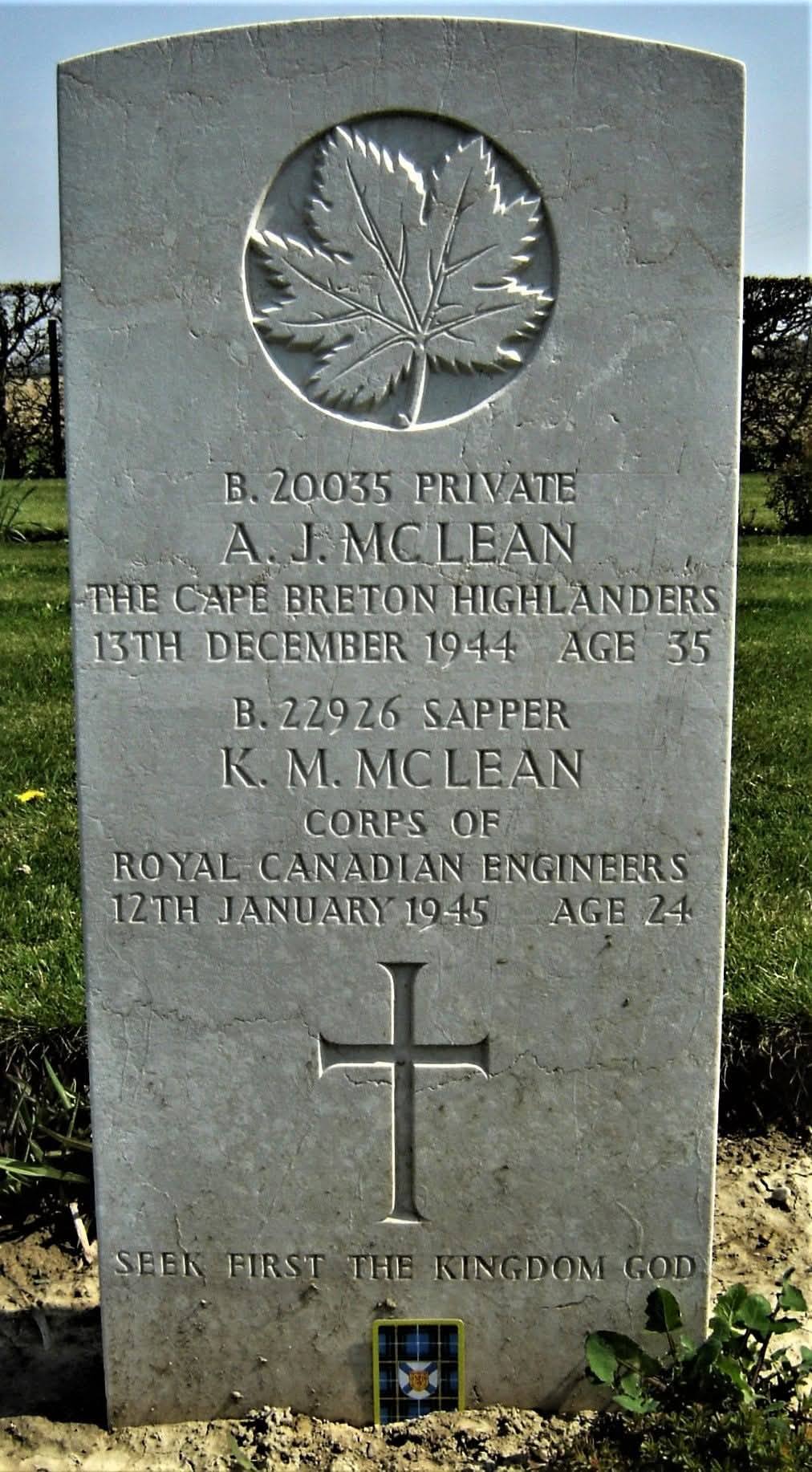
La tomba comune dei fratelli McLean al Villanova Canadian War Cemetery / The shared grave of the McLean brothers at Villanova Canadian War Cemetery
Il mistero di Le Havre The Le Havre mystery
Un elemento ancora non chiarito riguarda il percorso successivo dell'elmetto. Il pezzo sarebbe stato recuperato, insieme a un elmetto tedesco, a Le Havre, nel nord della Francia. Come l'elmetto di McLean sia arrivato lì rimane, almeno per ora, un mistero. Potrebbe trattarsi di uno spostamento avvenuto dopo la morte del soldato, di una raccolta di materiali, di un trasferimento postbellico o di una vicenda collezionistica ormai impossibile da ricostruire con certezza. One point remains unclear: the helmet's later journey. The piece was reportedly recovered, together with a German helmet, in Le Havre, in northern France. How McLean's helmet ended up there remains, at least for now, a mystery. It may have been moved after his death, gathered with other material, transferred after the war, or passed through a collecting history that can no longer be reconstructed with certainty.
Osservazioni sull'elmetto Notes on the helmet
Dal punto di vista collezionistico l'elmetto è un MKII canadese GSW 1940. Il dettaglio che mi aveva inizialmente colpito è il montaggio inverso dei supporti del liner, visibile osservando l'interno. Le marcature manoscritte, tuttavia, sono l'elemento che trasforma il pezzo da semplice oggetto tecnico a reperto storico personale. Non siamo davanti a un elmetto anonimo: il nome, il numero di servizio e il riferimento al Canadian Forestry Corps permettono di restituirgli una storia precisa. From a collecting point of view, the helmet is a Canadian MKII GSW 1940. The feature that first caught my attention was the reversed mounting of the liner lugs, visible inside the helmet. The handwritten markings, however, are what transform the piece from a technical object into a personal historical artefact. This is not an anonymous helmet: the name, service number and Canadian Forestry Corps reference allow its story to be restored.
.jpg)
.jpg)
Vista esterna e interna dell'elmetto / External and internal views of the helmet
La vicenda di Alexander James McLean mostra bene come un oggetto apparentemente marginale possa aprire una finestra su una storia molto più ampia: il lavoro dei reparti forestali canadesi, la crisi dei rincalzi nella Campagna d'Italia, il trasferimento di uomini dai servizi di supporto alla fanteria, il combattimento nella zona del Lamone e, soprattutto, il sacrificio di due fratelli canadesi caduti in Italia a distanza di un solo mese. The story of Alexander James McLean shows how an apparently minor object can open a window onto a much wider history: the work of Canadian forestry units, the replacement crisis in the Italian Campaign, the transfer of men from support services to infantry, the fighting in the Lamone area and, above all, the sacrifice of two Canadian brothers who died in Italy only one month apart.
Un elmetto acquistato per una particolarità costruttiva si è così rivelato un testimone silenzioso di una vicenda umana molto più profonda. Dietro le iniziali tracciate all'interno del guscio non c'è soltanto un numero di matricola, ma un uomo, una famiglia, un fratello caduto poco dopo di lui e una tomba comune in un cimitero canadese in Italia. A helmet acquired for a construction detail has thus turned out to be a silent witness to a far deeper human story. Behind the initials written inside the shell there is not only a service number, but a man, a family, a brother who fell shortly after him, and a shared grave in a Canadian cemetery in Italy.
Lest we forget.
Fonti e riferimenti Sources and references
- Marcature e osservazioni dirette sull'elmetto in collezione privata.
- Profilo biografico di Alexander James McLean pubblicato da Wartime Friends.
- Testo commemorativo di Gary Silliker sui fratelli Alexander James McLean e Keith Mabin McLean.
- Documentazione cimiteriale relativa al Villanova Canadian War Cemetery, tomba 7B3.
Collezione privata Daniele Piselli.
- Markings and direct observations on the helmet in private collection.
- Biographical profile of Alexander James McLean published by Wartime Friends.
- Commemorative text by Gary Silliker on the brothers Alexander James McLean and Keith Mabin McLean.
- Cemetery documentation relating to Villanova Canadian War Cemetery, grave 7B3.
Private collection Daniele Piselli.

